December 18, 2025·Ecosystem
Multi-Tenant Ecommerce: Different Medusa Use Cases
Greg Tomaka

Greg Tomaka
Learn how Medusa fits into a multi-tenant commerce architecture; what is supported out of the box, and the scenarios that illustrate different multi-tenancy models.
Medusa Expert post
This article is written by Medusa Expert partner, Rigby. It covers an excerpt from their new multi-tenant guide, which can be found below.
Multi-tenant architecture is a rising ecommerce architecture pattern, but clear technical guidance is still hard to find. In our eBook “Multi-Tenant Architecture in eCommerce: The Complete Guide (2026 Edition)” we pull that knowledge into one place, with a strong focus on implementation on top of a composable Medusa engine.
At its core, multi-tenant architecture is a model where one software system serves multiple independent tenants while keeping their data completely separated. Tenants share infrastructure and often the same physical server or cloud services, but each tenant’s data and settings are kept separate. In ecommerce, a tenant is typically a brand, franchise group, or dealer, while the platform owner manages the underlying system as a service.
Medusa plays a specific role in this setup. Unlike closed SaaS platforms, it does not hide the backend. You have direct control over how application instances are deployed, how databases are separated, and how routing and provisioning logic is implemented.
Core Capabilities for Multi-Tenant Platforms
Below you’ll see what Medusa provides out of the box, what needs to be added when building a multi-tenant platform, and why Medusa’s internal architecture fits these scenarios.
Medusa’s native multi-story
Medusa ships with multi-store support inside one backend instance, allowing a single deployment to manage multiple storefronts.
A single Medusa instance can host multiple storefronts that share:
- database, product catalog, and inventory,
- order management system,
- promotions and tax rules,
- third-party integrations,
- core domain workflows.
Each storefront can differ in: domain, language, regional rules, currency, and branding.
This model works for:
- Multi-brand organizations controlled by a single team.
- Expansions into multiple countries.
- Companies operating many consumer storefronts built on one backend.
Because all storefronts share the same underlying engine and data, updates, deployments, and integrations stay unified.
Medusa’s role in custom multi-tenant platforms
Medusa does not provide multi-tenancy natively, but its architecture makes it straightforward to extend it for more advanced or isolated scenarios.
In a multi-tenant design:
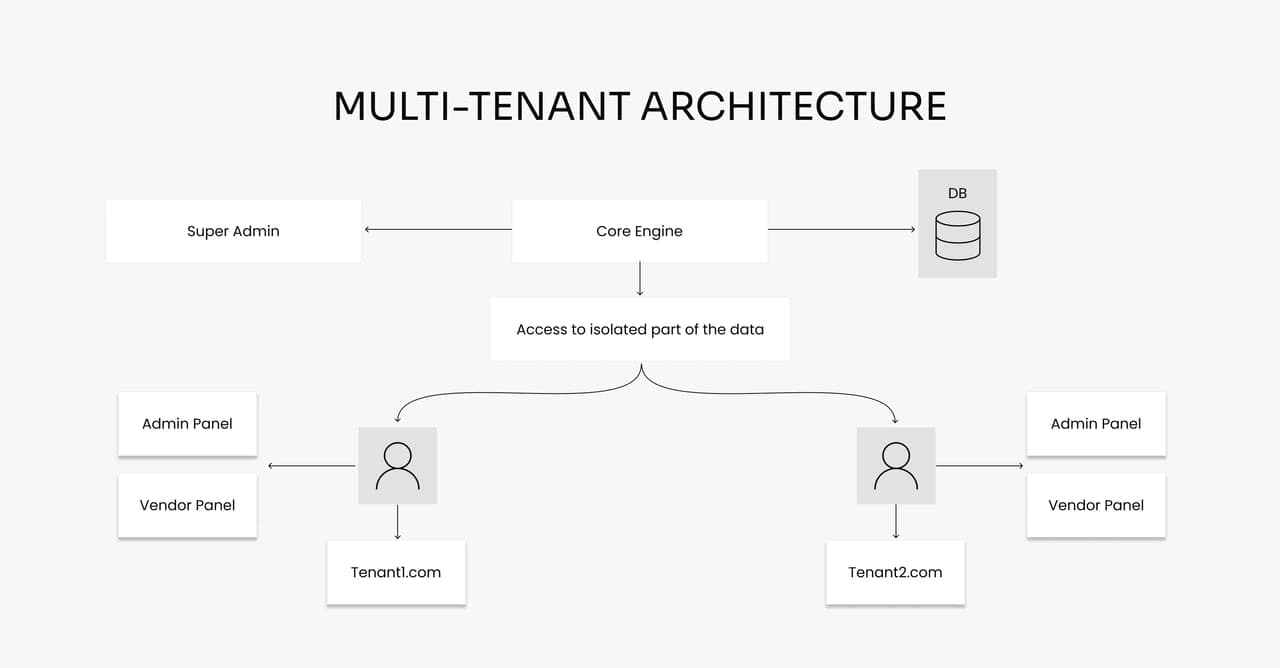
- each tenant receives its own Medusa instance with an admin panel, a vendor panel, and a data space (full isolation),
- each brand operates as a separate business on your custom platform,
- a platform-level super-admin oversees all tenants,
- provisioning logic creates new instances and databases,
- each tenant gets separate onboarding, billing system, reporting, and analytics.
This model works for:
- Franchise networks where each franchisee requires isolated customers, orders, and staff but must follow shared catalog and pricing rules.
- Dealer or distributor ecosystems where each partner operates its own storefront under one platform.
- Businesses expanding into many regions, where each region requires its own backend environment.
Why Medusa is a strong foundation
A multi-tenant platform needs a predictable engine that can be plugged into different isolation models, wrapped by its own tenant layer, and driven by external orchestration. Medusa gives you that engine without enforcing a fixed deployment shape or hiding the internals behind a vendor boundary.
Composable and headless architecture
Medusa exposes all commerce functionality through APIs and modules, without tying the user to a fixed frontend or monolithic admin. This allows:
- routing layers to sit in front of Medusa and direct traffic per tenant,
- tenant-specific frontends to connect to different Medusa instances,
- platform-level systems (billing, tenant registry, provisioning) to wrap around Medusa.
Support for extension layers
Medusa’s architecture is built around modular extensions: custom services, modules, and workflows, making it possible to build tenant-specific logic where required.
Multi-tenant platforms rely heavily on extension layers to connect cross-tenant analytics systems or tax/fulfillment/payment connectors that differ across tenants.
Easy integration with provisioning systems
Multi-tenant platforms require automated provisioning of tenants, instances, and databases. Medusa instances allow provisioning systems to:
- spin up new tenant instances on demand,
- clone template databases,
- apply environment-specific overrides per tenant,
- connect platform credentials to the correct instance.
Multi-Tenant Architecture Scenarios with Medusa (The Three-Model Framework)
Medusa’s engine can be arranged in several architectural patterns depending on how much isolation each tenant needs.
Here are three practical scenarios that show how Medusa’s components fit together to support different forms of multi-tenancy.
Scenario 1: Single-Tenant Multi-Store
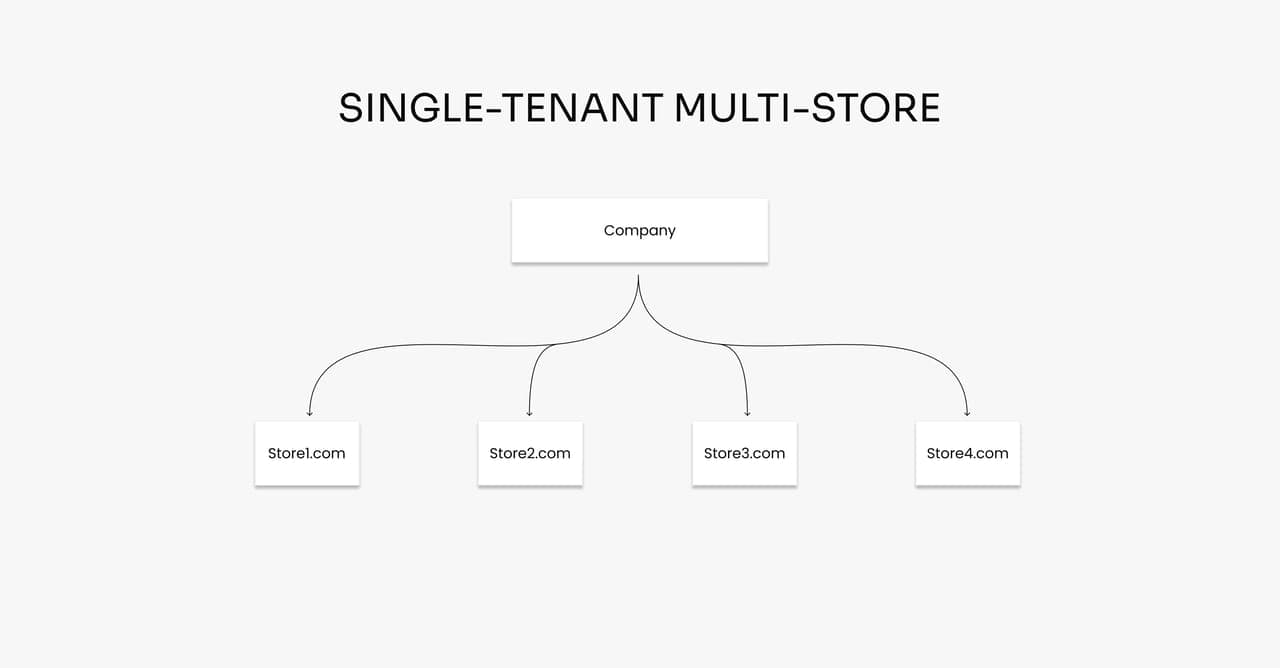
A single Medusa instance powering multiple storefronts under one organization.
Some companies operate several brands or regional storefronts that share the same backend team, product catalog, and operational workflows. Each storefront has its own branding, content, and customer-facing logic, while the backend remains unified.
The company deploys Medusa once. It works in:
- A single admin panel.
- One shared database, inventory, and order system.
- Four different storefronts with different branding.
- Multiple stores where the same product can appear.
What Medusa provides OOTB
- Multi-store management.
- Different currencies/regions per store.
- Shared product catalog.
- Unified order management.
- Sales channel support: Assign products and inventory availability to specific channels, which helps control what each storefront can sell and how catalog visibility is segmented across stores.
What you need to build
Nothing. This setup maps directly to Medusa’s out-of-the-box multi-store capability.
When this model fits
This model fits when one company owns multiple brands and runs them as a single operational unit. Leadership gets unified visibility across revenue, inventory, and orders, while a central team controls pricing and promotions for all stores. Products can be reused across storefronts, operational costs stay low because there is only one backend to maintain, and new storefronts can launch quickly without provisioning another instance.
Scenario 2: Multi-Tenant Platform
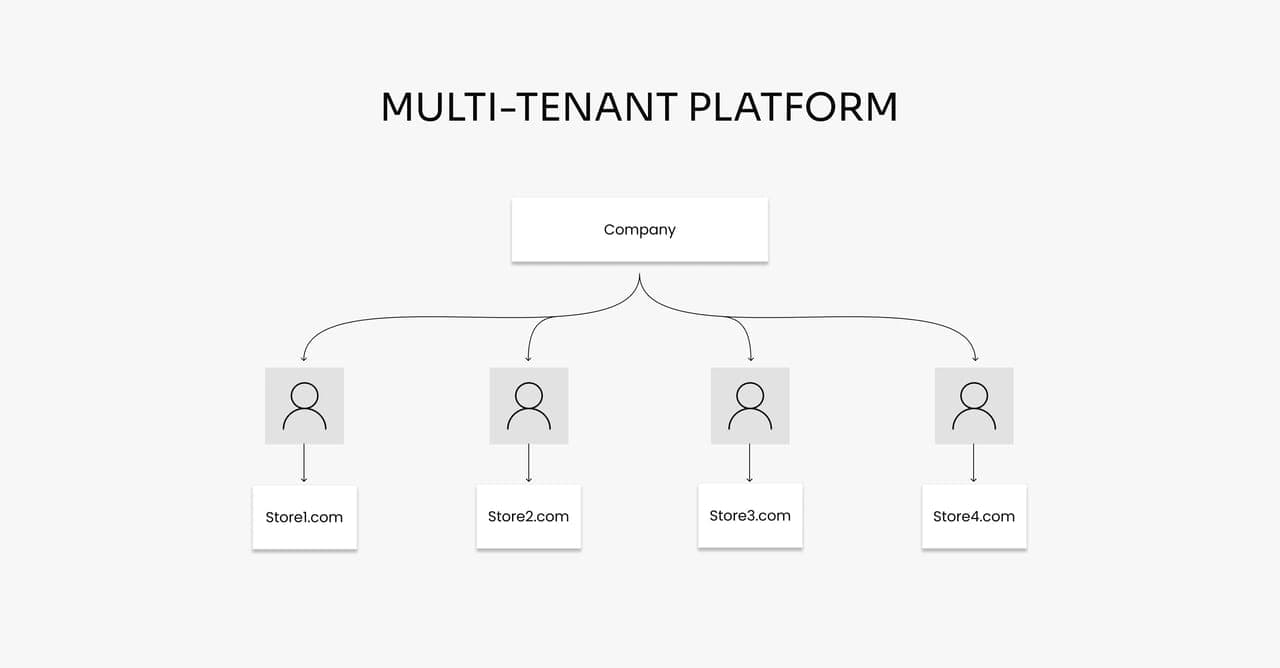
In this model, the platform owner builds a system that hosts many independent tenants.
Each tenant gets its own Medusa instance, database, and tenant-level admin panel. Tenants do not share data or operational context. From the tenant’s perspective, the platform behaves like a private ecommerce backend dedicated only to that tenant.
The platform owner uses a separate super admin panel to oversee all tenants from above. From the platform owner’s perspective, it is a classical multi-tenant architecture with strong isolation between tenants.
What Medusa provides OOTB
- Individual Medusa instances per tenant.
- Standard ecommerce features per instance.
What you need to build
To run many isolated Medusa instances under one platform, the following components must be implemented:
- A platform layer that manages multiple Medusa instances.
- Tenant isolation and data separation.
- Super admin dashboard to oversee all tenants.
- Billing system per tenant.
- Tenant onboarding and provisioning.
- Cross-tenant analytics and reporting.
When this model fits
This model fits when tenants must run as independent businesses with strict separation. The platform owner can track high-level metrics in a super-admin view without exposing any tenant’s internal data, while each tenant controls its own catalog, pricing, staff, and workflows. It allows tenant-specific integrations like payment providers, and matches a platform model where tenants are billed separately for their own environment.
Scenario 3: Multi-Tenant + Multi-Store
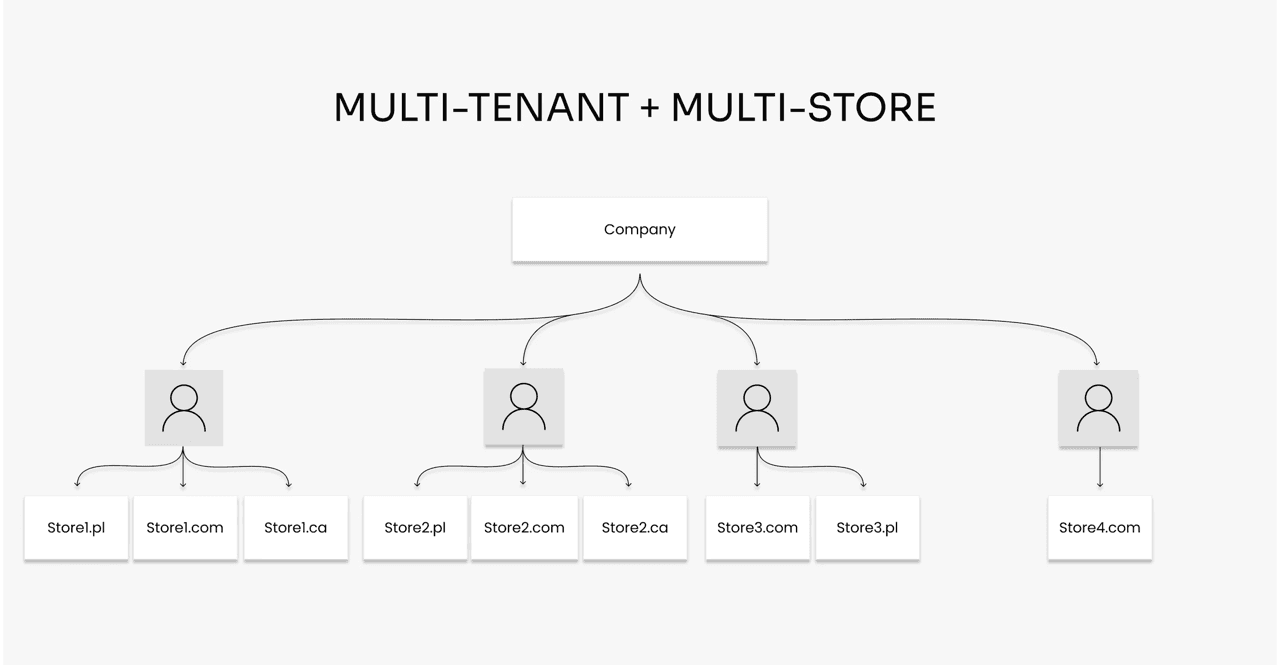
Some commerce ecosystems operate at two distinct levels:
- Independent tenants that run as separate businesses.
- Multiple storefronts inside each tenant, often representing regions, locations, or sub-brands.
Each tenant needs full isolation from other tenants, but within their environment, they want the flexibility to run many storefronts without provisioning a new backend each time.
Medusa supports this architecture by combining a custom multi-tenant platform with its native multi-store feature.
What Medusa provides OOTB
- Multi-Store feature within each tenant's Medusa instance.
- Each tenant can manage multiple storefronts from their admin.
What you need to build
- Platform layer managing multiple Medusa instances (tenants).
- Super admin dashboard with multi-level visibility.
- Tenant isolation and provisioning.
- Cross-tenant reporting and analytics.
- Billing per tenant (not per store).
When this model fits
This scenario fits when each franchise is an independent business but still needs to run multiple locations under one tenant. New franchises can be onboarded as tenants and launch several stores immediately. Franchise owners can manage all locations from one place and pay once for the tenant environment.
Conclusion
The challenge of multi-tenant architecture is implementing it in a way that gives you control over data isolation, operations, and long-term scalability.
The key takeaway is that Medusa makes it possible to build multi-tenant systems that SaaS platforms cannot support without workarounds or loss of control. It gives you the flexibility to choose how tenants are isolated, how instances and databases are structured, and how the platform layer around the engine is designed.
If you’re planning to build or evolve your multi-tenant commerce, explore our whole eBook “Multi-Tenant Architecture in eCommerce: The Complete Guide (2026 Edition)” for a deeper dive into the topic.
Get the eBook
Access the full eBook behind this article: Multi-Tenant Architecture in eCommerce: The Complete Guide (2026 Edition)