
September 29, 2026·User stories
Healthletic: 30% Checkout Lift After Shopify Plus Migration
Nicklas Gellner

Nicklas Gellner
Learn how Healthletic moved its commerce engine off Shopify Plus to Medusa, lifting checkout conversion +30% on a $24M+ yearly GMV business, without disrupting fulfillment or existing subscribers.
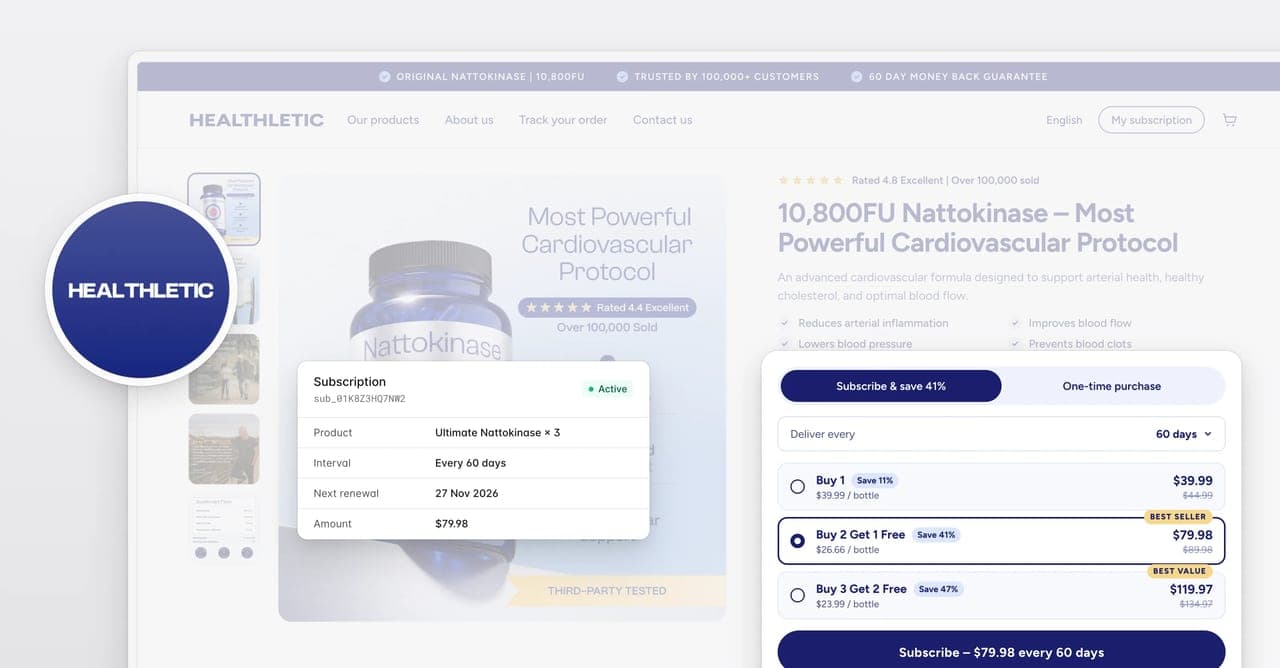
Healthletic is a D2C brand selling dietary supplements and wellness formulas as one-time purchases and recurring subscriptions. Yearly, the business draws 3.8M+ visitors, processes 240,000+ orders, and generates $24M+ in yearly GMV. It is live across six markets, with the US carrying roughly 70% of volume alongside the UK, Australia, Canada, South Korea, and France.
Healthletic was running on Shopify Plus, where platform and checkout fees scaled with every order and renewal. The brand wanted a more flexible platform where costs aren't tied to their GMV, but switching meant putting its subscription business at risk, along with every subscriber already billing on it.
In the first month after the migration, checkout conversion is around 30% higher than on Shopify Plus. Platform costs behave differently too: Medusa is open source, so Healthletic now pays to run the platform, and selling more no longer raises the platform bill.
We see better performance of our Medusa storefront vs Shopify. Seems we can definitely beat Shopify!Deividas Daubaris
·
CEO at Healthletic
Healthletic worked with Rigby, a Medusa Expert partner, to move its platform to Medusa, keeping Shopify for old subscriptions and fulfillment.
When Subscription Growth Made Shopify Plus Expensive
While running on Shopify Plus, Healthletic paid a total of $25,000 per month in platform and transaction fees.
In a subscription business, the same customer is billed again and again, so the percentage fee repeats for the lifetime of every subscription, and the platform bill climbs with each renewal instead of flattening as the subscriber base matures.
Shopify's checkout also ties payment processing to a fixed set of methods and one fee structure. Healthletic could not add payment options beyond what that checkout supported, or decide where in the flow those options appeared.
The subscription base was a constraint in the setup. Healthletic's recurring billing was wired into its existing fulfillment and support tooling, which made a one-to-one migration too complex and too central to attempt in a single project. A single cutover risked breaking recurring billing for subscribers already on file and interrupting checkout mid-purchase. Any new platform had to run alongside the existing setup.
A Phased Migration to Medusa
Rigby built a new platform on a Medusa backend and put it live alongside the existing Shopify setup. Medusa handles the commerce logic, storefront, checkout, and every new subscription. Shopify stays in place as a bridge for two things: the subscriptions that were already billing when the new stack went live, and fulfillment.
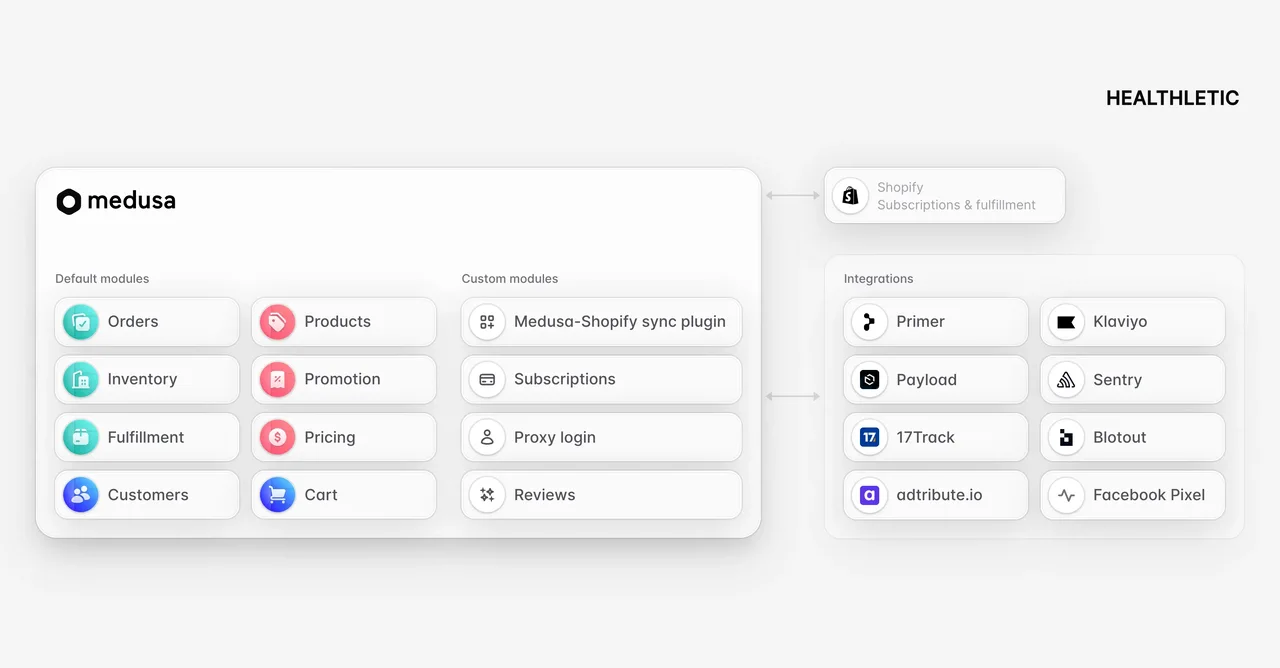
A custom Medusa-Shopify sync plugin connects the two sides. Every order placed on the new storefront, including every renewal the subscription module charges, syncs automatically into Shopify. Healthletic's fulfillment, 3PL, and CommsLayer-based support tooling carry on working from the same order records as before, so no part of the operations layer had to be rebuilt to match the new platform.
Returning customers are handled through a proxy login. A customer with an existing Shopify account is recognized at login and routed into that account, with order and subscription history intact. New customers go straight through the Medusa account and checkout flow.
This setup was designed as the first phase of a full migration to Medusa. Keeping existing subscriptions and fulfillment on Shopify reduced the risk of disrupting live billing and operations, while allowing Healthletic to launch the new storefront, checkout, and subscription experience sooner. Healthletic plans to move the remaining Shopify workflows to Medusa in later phases.
Building Subscriptions as a First-Party Medusa Module
Subscriptions are the core of Healthletic's business, so Rigby built the subscription engine as a first-party module inside the Medusa backend. Billing logic, customer-facing controls, and the product catalogue run in one system.
The same product sells as a one-time purchase or a subscription, with the choice modelled as a product variant option. Subscriptions renew on weekly, monthly, or yearly cadences. Customers change the cadence themselves after subscribing.
Self-service was built out far enough that routine subscription changes never reach support. From their account, a subscriber can:
- Pause, resume, or cancel a subscription
- Skip the next order
- Order now, charging and shipping the next order immediately
- Change billing frequency
- Reschedule the next billing date
- Add or swap products on the upcoming order
- Update the payment method, card or PayPal
- Edit shipping details
- Apply a discount code
- View order history and a full activity log of every change
A scheduled job runs once daily and processes every subscription due that day. Renewals are charged off-session against a securely vaulted payment token, with no customer action. Billing runs across cards, Apple Pay, and Google Pay through Primer, with a native PayPal path alongside, and each renewal order syncs into Shopify for fulfillment and 3PL handling.
Failed renewals are recovered rather than written off. A failed charge moves the subscription to past-due and starts an automatic retry sequence of up to 5 attempts, with a marketing email at each step. A subscription recovered anywhere in that sequence returns to active on its original renewal date, so a card failure never pushes the billing schedule later.
Because recurring billing runs unattended, the module carries safeguards against double charges, missed runs, and inconsistent state: de-duplication holds a customer to one charge per renewal even if the daily job runs twice; a backup scheduler picks up a missed run, keeping billing days intact through deployments; payments are authorized in sequence, so a declined card never creates a ghost order; and every subscription change and billing event lands in an audit log.
Speeding Up Development with Agentic Tools
Rigby also used AI tooling to speed up implementation on the build. The project ran off an AGENTS.md file that gave developers and coding agents one shared brief: architecture, conventions, and why the main decisions were made.
Medusa's own tooling supported the development work: the MCP server for documentation and curated implementation guides, Medusa's agent skills for building features against the framework, the Docs Agent for fast lookups against the current Documentation, and Cloud CLI for logs, errors, and environment changes. The tooling helped most on the custom work, including the subscription module, the sync plugin, and the proxy login flow.
Payments Healthletic Controls and +30% at Checkout
Healthletic moved for cost because, at their volume, the Shopify Plus bill had become the problem, and switching platforms was how they fixed it. Conversion wasn't the main goal going in, but customers noticed the difference right away, and it showed up in the numbers. The storefront was rebuilt from the ground up, design included, with a fully custom checkout instead of Shopify's hosted one.
Primer sits between Healthletic's checkout and multiple payment methods and processors, handling PayPal, Apple Pay, Google Pay, and card payments along with refunds. Healthletic controls how payments are routed and where each method appears.
The wallets show up twice in the flow. PayPal, Apple Pay, and Google Pay sit at the very start of checkout, so a customer with wallet details saved can pay before typing anything. Anyone who scrolls past reaches the standard payment step, where the same three wallets appear again alongside card entry. On a hosted checkout, that arrangement is set by the provider.
You may also like
August 27, 2026·User stories
6,000+ Products Matched to Every Vehicle Type

Carla Böddeker

February 24, 2026·User stories
No developer, from idea to go-live in two weeks with Bloom

Oliver Juhl & Nicklas Gellner

December 11, 2025·User stories
80% Cost Savings: AI-Powered Email Order Processing at INSPIRED Pet Nutrition
Nicklas Gellner & Carla Böddeker